Nearly 48% of foodborne illness outbreaks trace back to unsafe cleaning practices in commercial kitchens. Not all sanitizers are created equal – some leave invisible risks on countertops, utensils, and prep surfaces long after they dry.
Food-grade products undergo rigorous testing to ensure they break down safely without toxic residues. Regulatory agencies like the EPA certify these solutions for direct contact with ingredients and cooking tools. Always check labels for registration numbers – your customers’ safety depends on it.
Using non-approved chemicals in food zones risks contamination and legal liability. Certified sanitizers balance effectiveness with consumer protection, eliminating pathogens while meeting strict ingestion safety standards. When in doubt, contact manufacturers directly to confirm compliance.
Key Takeaways
- Food-contact sanitizers require EPA certification to prevent chemical contamination
- Check product labels for registration numbers and food-surface approvals
- Non-certified cleaners may leave dangerous residues on prep areas
- Manufacturer testing ensures safe breakdown of active ingredients
- Proper selection reduces health risks and business liability
Introduction to Food-Safe Cleaners
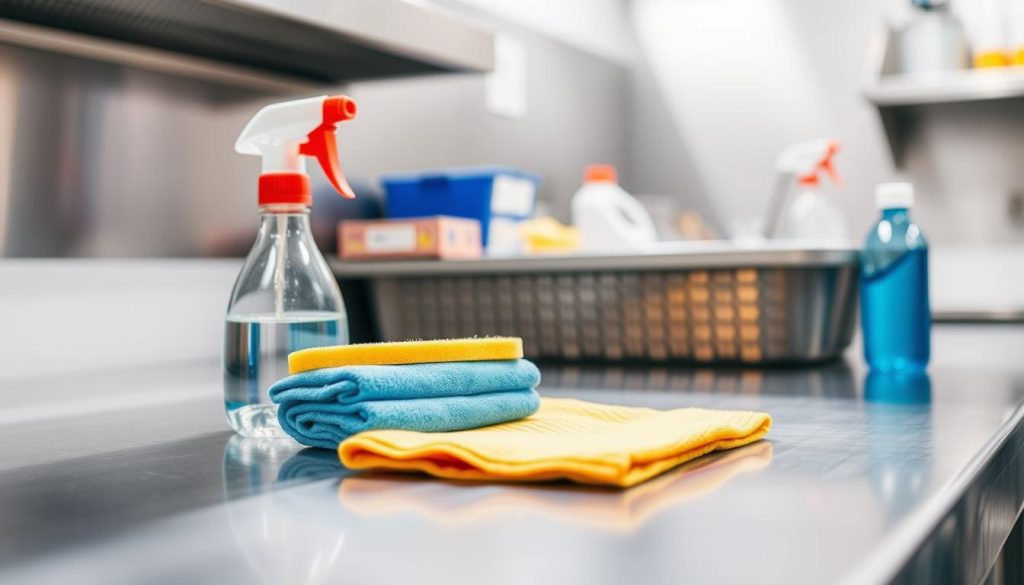
Restaurants and food facilities face hidden dangers where meals are prepared. Every countertop, utensil, and serving tray could harbor dangerous pathogens if not properly treated. Choosing the right solutions for your operation prevents invisible threats from reaching customers.
Protecting Public Health Through Surface Management
High-traffic zones in food establishments require constant vigilance. Harmful bacteria like Salmonella and E. coli thrive on improperly cleaned equipment. Cross-contamination often starts where staff least expect it – door handles, menu boards, or ice machines.
Effective protocols address both visible dirt and microscopic risks. Direct contact zones (cutting boards, prep tables) demand immediate attention after use. Indirect areas (storage shelves, cart handles) need scheduled treatments to prevent silent contamination spread.
Identifying Critical Zones in Your Facility
Over 60% of outbreaks originate from overlooked surfaces. Train teams to recognize all potential risk areas:
- Preparation stations and cooking tools
- Dining area furniture and condiment dispensers
- Transport equipment and storage containers
Sanitizers approved for food-contact use break down safely without leaving harmful residues. Always verify EPA registration numbers on labels – this ensures products meet strict safety standards for surfaces touching ingredients.
What Makes a Cleaner “Food-Safe”?
Kitchen safety hinges on selecting sanitizers designed for surfaces that touch ingredients. Non-approved products might kill germs but leave harmful residues. Always check labels for EPA registration numbers – these confirm a product meets strict standards for food-contact areas.
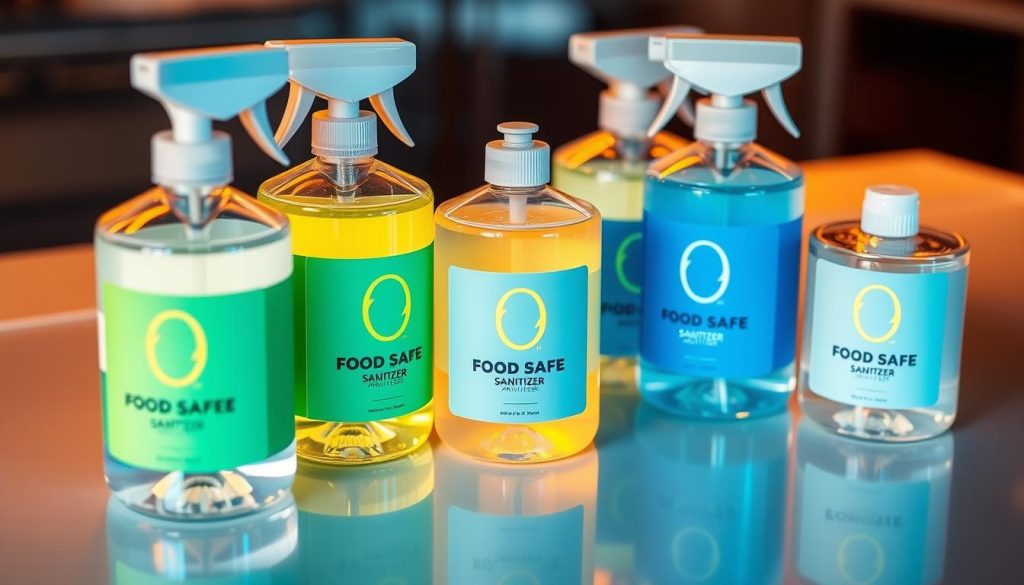
Strong cleaning power doesn’t guarantee safety. Some industrial-grade sanitizers contain toxins that linger on countertops or utensils. Look for phrases like “safe for food surfaces” or “no-rinse required” when evaluating products.
| Feature | Approved Sanitizers | Non-Approved Sanitizers |
|---|---|---|
| Residue Safety | Break down harmlessly | May leave toxic traces |
| Label Information | EPA registration number | Missing compliance data |
| Surface Compatibility | Food-contact certified | General use only |
Train staff to recognize certified products through daily practice. Keep a master list of approved cleaners near storage areas. When uncertain about a product’s status, contact the manufacturer directly – don’t risk guesswork in food prep zones.
Regulatory testing ensures approved solutions eliminate pathogens without endangering consumers. These products undergo rigorous checks for both effectiveness and safe chemical breakdown. Your compliance depends on using verified sanitizers at every cleaning stage.
Key Ingredients and Approved Sanitizing Chemicals
Commercial kitchens have five primary weapons against pathogens hiding on prep surfaces. Approved sanitizers rely on specific active ingredients that meet strict safety standards while destroying harmful microbes. Understanding these chemicals helps teams balance effectiveness with regulatory compliance.
Exploring Hypochlorites, Chlorine Dioxide, and Iodophors
Hypochlorite-based solutions dominate commercial spaces due to their affordability and proven track record. These sanitizers work best at 200 ppm concentrations – exceeding this limit risks corrosive effects on equipment.
Chlorine dioxide offers similar power at half the strength, requiring just 100 ppm for optimal results. Its lower concentration makes it gentler on surfaces while maintaining rigorous disinfection standards.
Iodophors shine in low-contact time scenarios. At 25 ppm, they eliminate pathogens quickly without leaving stubborn stains. Many dairy processors favor these chemicals for their rapid action on stainless steel surfaces.
Understanding Quaternary Ammonium and Peroxyacetic Acid
Quaternary ammonium compounds (quats) provide lasting protection on non-porous surfaces. Applied at 200 ppm, they create an invisible barrier against microbial growth between cleanings. Food manufacturers often choose quats for conveyor systems and packaging areas.
Peroxyacetic acid (PAA) solutions excel where others struggle. “PAA penetrates biofilms in refrigeration units that standard sanitizers might miss,” notes a USDA compliance officer. Their effectiveness in cold environments (100-200 ppm) makes them ideal for meat processing plants.
| Chemical | Food-Safe Concentration | Best Use Case |
|---|---|---|
| Hypochlorites | 200 ppm | General surface disinfection |
| Chlorine Dioxide | 100 ppm | Delicate equipment |
| Iodophors | 25 ppm | Quick sanitation cycles |
| Quaternary Ammonium | 200 ppm | Non-porous surfaces |
| Peroxyacetic Acid | 100-200 ppm | Cold storage areas |
Always verify concentration requirements with test strips before application. Matching chemicals to specific tasks ensures both food safety and operational efficiency.
The Role of Cleaning versus Sanitizing in Food Safety
Effective contamination control relies on executing two distinct processes in precise order. Cleaning removes visible debris, while sanitizing targets invisible pathogens – skipping either step creates dangerous gaps in protection.
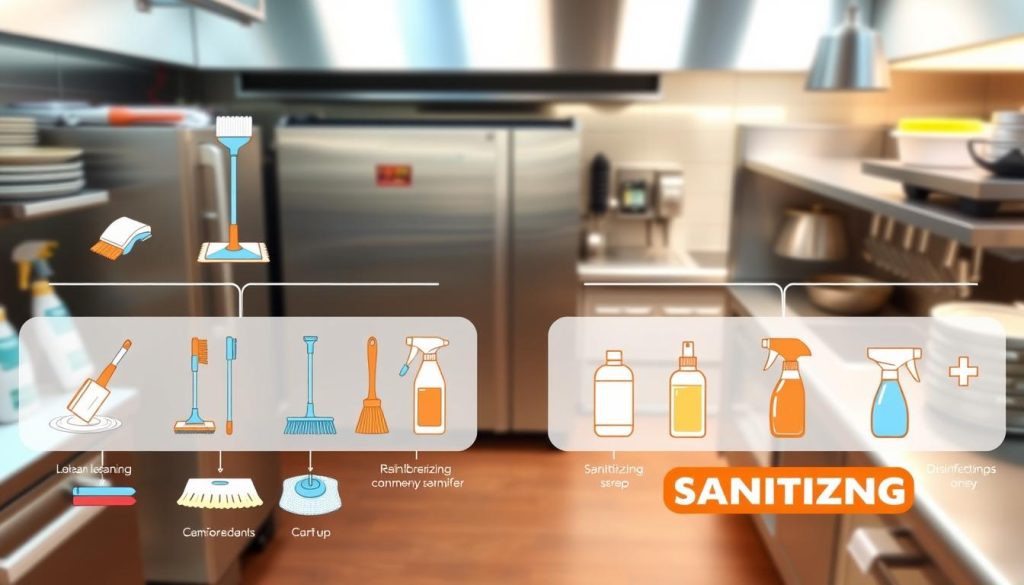
Steps to Proper Cleaning Before Sanitization
Start by scraping food particles from contact surfaces using disposable towels. Apply detergent solution (120°F optimal) with separate cleaning tools for raw and cooked food zones. Always rinse thoroughly – soap residue neutralizes sanitizers.
Common mistakes include:
- Reusing contaminated cloths across multiple areas
- Using cold water that fails to dissolve grease
- Rushing the rinsing phase
Essential Sanitizing Protocols for Food-Contact Surfaces
After cleaning, apply EPA-approved solutions at specified concentrations. Allow proper contact time – most sanitizers require 30+ seconds to eliminate pathogens. Air drying prevents recontamination from towels.
Critical reminders for teams:
- Test chemical strength daily with strips
- Never mix different sanitizer types
- Label all containers with preparation times
Establish color-coded tools for each process – blue cloths for cleaning, green for sanitizing. This visual system prevents cross-use errors that compromise food safety standards.
Regulatory Standards and Compliance for Food-Safe Sanitizers
Two federal agencies guard against chemical risks in food preparation areas. The Environmental Protection Agency classifies sanitizers as pesticides, requiring rigorous testing for surfaces touching ingredients. Meanwhile, the Food and Drug Administration evaluates solutions for safe breakdown during food processing.
Reviewing EPA and FDA Guidelines
Always check product labels for an EPA registration number – this confirms compliance with pesticide regulations. The drug administration branch of FDA separately approves specific chemicals like chlorine dioxide for food-contact applications.
Your facility must maintain records showing all sanitizers meet both agencies’ standards. “Approved use depends on exact concentration levels and application methods,” states a recent FDA compliance memo. Never assume a cleaner is food-safe without verifying dual approvals.
Update your chemical inventory quarterly to reflect regulatory changes. Manufacturers must reformulate products when guidelines evolve – using outdated solutions risks violations. Train staff to recognize current EPA registration numbers during supply orders.
Key compliance steps include:
- Cross-referencing EPA registration with FDA food-contact clearances
- Documenting concentration levels match approved use instructions
- Archiving safety data sheets for all sanitizing agents
Non-compliant products create legal exposure and health hazards. Partner only with suppliers who provide current certification documents for sanitizers approved under both regulatory frameworks.
Effective Application and Dilution Techniques
Precision transforms ordinary cleaning into true food protection. Proper chemical handling ensures sanitizers work as intended without creating new risks. Every step matters – from mixing solutions to timing their effectiveness.
Following Manufacturer Label Instructions
Label dilution guidelines exist for good reason. Manufacturers test their formulas at specific concentrations to balance safety and germ-killing power. Deviating from these instructions risks creating toxic residues or ineffective solutions.
Always follow manufacturer ratios when preparing sanitizers. Use measuring tools rather than guessing – even small errors matter. For example, 100 ppm chlorine dioxide requires exact water-to-chemical proportions to function properly.
Ensuring Proper Contact Time and Correct Dilution
Sanitizers need adequate contact time to destroy pathogens. Most formulas require surfaces to stay wet for 10-30 seconds. Set timers during training to build proper habits.
Test strips verify concentration accuracy throughout shifts. If 100 ppm drops to 80 ppm, add fresh solution immediately. Document these checks to maintain compliance and staff accountability.
Remember: proper dilution protects customers twice – first by killing germs, then by preventing chemical hazards. When teams follow manufacturer specs precisely, they create kitchens where safety and cleanliness coexist.