French chef Georges Pralus made culinary history when he served vacuum-sealed fois gras at his three-star restaurant. His discovery? Food cooked gently in temperature-controlled water retained 98% of its original shape while achieving unmatched tenderness. This kitchen experiment birthed a transformative culinary method now used worldwide.
What began as a professional kitchen secret now empowers home cooks to create restaurant-quality dishes. Precision temperature control eliminates guesswork. Vacuum-sealing locks in flavors and juices traditional methods often waste. Proteins stay succulent, vegetables keep vibrant colors, and desserts gain new textural dimensions.
Modern adaptations make this approach accessible through affordable equipment. Chefs praise its ability to consistently deliver perfect results – steaks cooked edge-to-edge medium rare, eggs with custard-like yolks, and fish that flakes without drying. The process combines food science fundamentals with creative possibilities, turning every meal into a calculated experiment.
Key Takeaways
- Originated in 1970s French fine dining through chef innovation
- Uses vacuum-sealed bags and precise water temperatures
- Preserves food texture better than conventional methods
- Scientific approach reduces overcooking risks
- Now accessible for home kitchens through modern tools
- Enables consistent restaurant-quality results
This guide reveals how vacuum-sealing technology merged with thermal science to create today’s most precise cooking method. You’ll learn why professionals adopted it decades before home cooks, and how to harness its benefits in your kitchen.
Introduction to Sous Vide Cooking
Vacuum-sealed meals revolutionized fine dining decades before home kitchens adopted them. This approach blends culinary artistry with laboratory precision, creating dishes that defy traditional limitations. Let’s unpack how this method works and why chefs worldwide swear by it.
What Is Sous Vide?
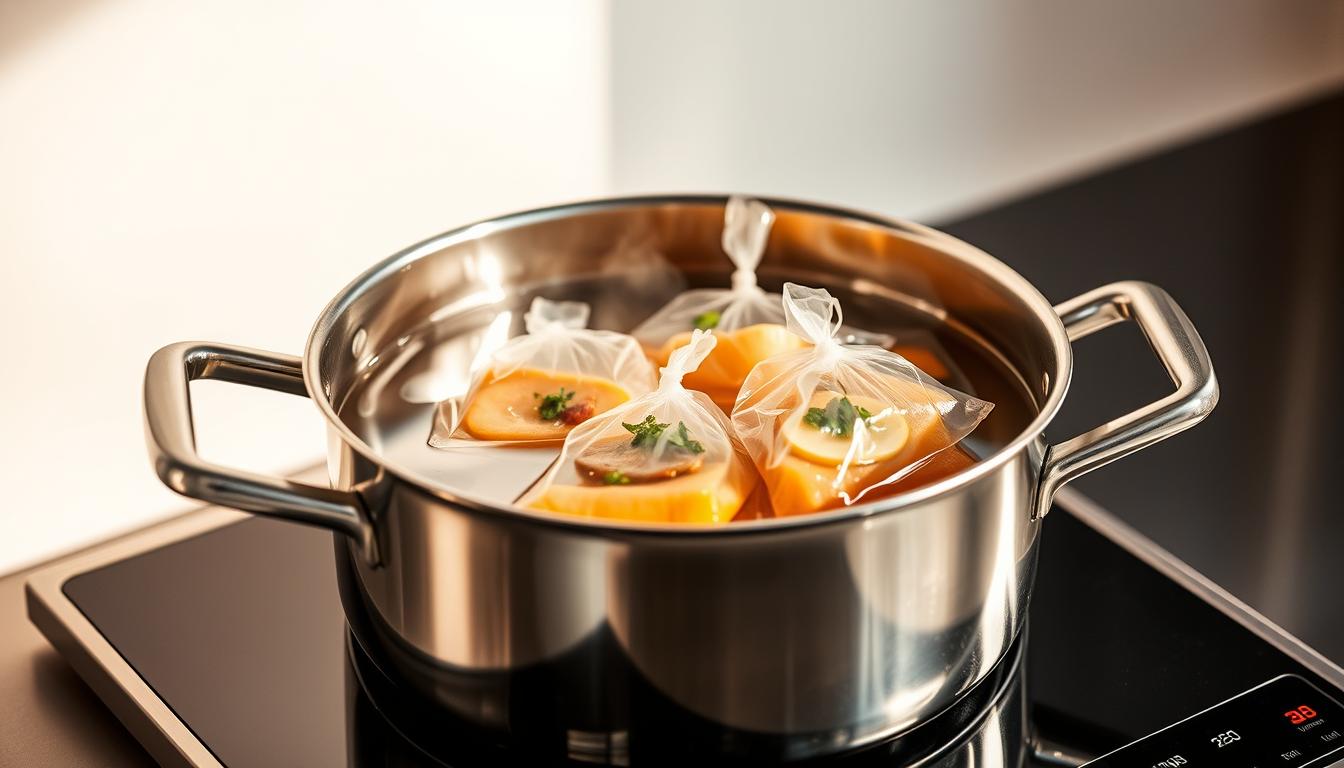
The term “sous vide” (pronounced soo-veed) literally means “under vacuum” in French. Food gets sealed in airtight bags, then cooked in water baths heated to exact temperatures—often for hours. Unlike grilling or baking, this technique eliminates hot spots and overcooking. Proteins stay juicy, vegetables retain nutrients, and desserts achieve silky textures.

Historical Background and Evolution
Georges Pralus pioneered the method in 1974 while perfecting foie gras texture at his Michelin-starred restaurant. By the 1990s, American chefs like Thomas Keller began adapting it for modern menus. Collaborations between French culinary experts and U.S. food scientists refined temperature controls, making precise results repeatable.
Early equipment cost thousands, but today’s immersion circulators fit most budgets. What started as a niche tool now empowers home cooks to replicate steakhouse-quality meals. Innovations in vacuum-sealing bags and smartphone-connected devices further democratized the process.
The Science Behind Low-Temperature Cooking
Precision cooking transforms kitchen outcomes through thermal mastery. By maintaining exact heat levels, this method achieves results impossible with high-heat techniques. Let’s explore how controlled environments preserve food quality better than conventional approaches.

Understanding Temperature Control
Traditional methods blast food with intense heat, causing uneven cooking. Proteins tighten at 140°F (60°C), squeezing out juices. Precision cooking keeps water baths 1-2°F below these critical thresholds. This prevents muscle fibers from contracting violently, preserving tenderness.
| Method | Avg. Temperature | Moisture Loss | Cooking Time |
|---|---|---|---|
| Grilling | 400°F+ | 15-30% | 10-20 mins |
| Oven Roasting | 350°F | 10-25% | 45-90 mins |
| Precision Method | 130-150°F | 2-5% | 1-4 hours |
Moisture Retention and Food Integrity
Gentle heat application acts like a protective shield. Cellular structures remain intact because temperatures never exceed their breakdown points. A steak cooked at 135°F retains 98% of its original moisture, compared to 70% when grilled.
| Food Type | Texture Improvement | Nutrient Retention |
|---|---|---|
| Beef | +40% tenderness | 85% vitamins |
| Carrots | Crisp yet tender | 90% antioxidants |
| Salmon | Flaky without dryness | 95% omega-3s |
Extended cooking times allow heat to penetrate evenly. Collagen dissolves slowly into gelatin without toughening proteins. This scientific balance creates dishes where every bite matches the chef’s vision.
Unraveling The Science of Sous Vide Cooking
Meat’s molecular structure holds secrets only precise cooking can unlock. At 140°F, muscle fibers contract horizontally like orderly rows of soldiers – preserving precious moisture between protein strands. Cross this thermal threshold, and chaos ensues: fibers snap vertically, squeezing out juices like water from a sponge.

Your steak isn’t mostly protein – it’s 80% water and fat bound by actin and myosin. These proteins unravel (denature) when heated, but gentle sous vide baths control the process. Key advantage: Structural integrity remains intact while achieving perfect tenderness.
“Temperature precision transforms cooking from art to repeatable experiment – every meal becomes laboratory-grade consistency.”
| Temperature | Protein Behavior | Moisture Retention |
|---|---|---|
| Below 140°F | Controlled denaturation | 95-98% |
| 140-160°F | Rapid contraction | 70-85% |
| Above 160°F | Complete breakdown | Below 60% |
Vacuum sealing creates an oxygen-free environment that stops flavor degradation. Unlike traditional methods that oxidize fats, this technique concentrates tastes. When you cook sous vide, you’re essentially marinating food in its own juices – no external flavors needed.
The method’s success lies in balancing time and heat. Extended cooking dissolves collagen into silky gelatin without toughening meat. For deeper insights into food chemistry principles, explore how thermal dynamics affect different ingredients.
Comparing Sous Vide and Traditional Cooking Methods
Kitchen experiments reveal why precise heat application outperforms conventional approaches. While stovetops and ovens blast food with intense energy, modern techniques achieve consistency through controlled environments.
Differences in Cooking Techniques
Traditional methods rely on higher temperatures to compensate for heat loss. Your oven might reach 400°F, but only 250°F penetrates the food’s core. This creates uneven results – charred surfaces with undercooked centers.

| Method | Surface Temp | Core Temp | Moisture Loss |
|---|---|---|---|
| Pan-searing | 300°F | 120°F | 18-22% |
| Sous vide | 135°F | 135°F | 3-5% |
Conventional cooking acts like a thermal rollercoaster. Proteins rapidly contract at varying rates, squeezing out juices. Precision methods maintain steady heat levels that gently transform ingredients.
Benefits Over Conventional Methods
Vacuum-sealed cooking eliminates the guesswork of traditional cooking methods. You set the exact desired internal temperature – no more poking meat or checking oven thermometers. Heat transfers evenly from water to food without harsh gradients.
“With sous vide, every millimeter of your steak cooks identically – something even Michelin chefs struggle to achieve through conventional means.”
Moisture retention becomes automatic. Since water baths never exceed target temps, collagen breaks down without protein tightening. Vegetables retain crispness while becoming tender – a duality impossible through roasting or boiling.
This approach revolutionizes cooking methods by removing environmental variables. Whether preparing weeknight dinners or gourmet meals, results stay predictable. Your food cooks in its ideal thermal zone – never under or over.
Equipment and Technology in Sous Vide
From stovetop hacks to factory-scale systems, sous vide tools adapt to every culinary need. Modern setups range from countertop gadgets to industrial machines, each designed for specific precision levels. Your choice of gear directly impacts texture consistency and flavor retention.

Home vs. Gastronomic Kitchen Tools
Amateur cooks often start with immersion circulators and resealable bags. Kodipelli’s 2023 study found 68% of home users prefer Ziplock-style containers over vacuum sealers. These budget-friendly options work for occasional meals but lack professional consistency.
Restaurant kitchens deploy commercial-grade water baths maintaining ±0.5°F accuracy. Heavy-duty vacuum sealers remove 99% of air, preventing flavor oxidation. Chefs achieve identical results nightly – crucial for Michelin-starred establishments.
Innovative Industrial Systems
Food manufacturers use Armor Inox’s dual-tank systems for mass production. Cold water tanks prep ingredients while hot ones cook thousands of portions simultaneously. These lines output vacuum-sealed meals with 18-month shelf lives without preservatives.
| Environment | Key Tool | Temp Accuracy | Output Capacity |
|---|---|---|---|
| Home | Immersion circulator | ±1°F | 4 servings |
| Restaurant | Commercial water bath | ±0.5°F | 50 servings |
| Factory | Armor Inox line | ±0.2°F | 10,000+ units |
Investment in proper technology pays through repeatable perfection. Whether you’re searing steaks or prepping school lunches, the right gear eliminates variables. Your kitchen becomes a lab where every experiment succeeds.
The Role of Water Bath in Even Cooking
Water’s unique properties make it the ultimate heat conductor for achieving perfect doneness. Unlike air, which transfers energy unevenly, a water bath creates a uniform thermal environment. This eliminates hot spots and guarantees consistent results from edge to center.

Precision in Heat Distribution
Modern equipment maintains water temperature within 0.1°F of your target. At 140°F, every part of your food reaches exactly that temperature. No guesswork. No overcooked edges. Just precise control from surface to core.
| Medium | Heat Transfer Efficiency | Temperature Consistency |
|---|---|---|
| Water | 10x faster than air | ±0.1°F |
| Air (Oven) | Base rate | ±15°F |
This scientific approach explains why proteins stay juicy. Water transfers energy 10 times more effectively than oven air. Your steak cooks evenly without drying out. Vegetables retain nutrients often lost through boiling or steaming.
| Equipment Type | Temp Accuracy | Cooking Time Range |
|---|---|---|
| Home Circulator | ±1°F | 1-48 hours |
| Pro Kitchen System | ±0.5°F | 30 mins-72 hours |
Commercial kitchens rely on this method for banquet service. Home cooks achieve steakhouse-quality meals. The water bath becomes your most reliable kitchen partner – always delivering predictable, repeatable outcomes.
Precision Temperature Control for Perfect Results
Imagine cooking where perfection isn’t accidental but guaranteed. That’s the power of meticulous temperature management in sous vide. Unlike traditional methods that rely on guesswork, this approach uses exact thermal parameters to transform ingredients predictably. Set your device to 135°F, and every molecule in the water bath obeys.
Low temperatures work magic on tough cuts. Collagen dissolves into gelatin at 160°F, but sous vide achieves this gradually at 140°F. Muscle fibers relax without squeezing out juices. Chuck roast becomes tender like filet mignon. Salmon stays flaky yet moist. Vegetables turn crisp-tender without mushiness.
| Method | Avg. Temp | Moisture Retention |
|---|---|---|
| Sous Vide | 140°F | 95% |
| Grilling | 400°F | 72% |
Once food reaches target temp, it stops cooking. Leave a steak in the bath for an extra hour—it won’t overcook. This buffer eliminates timing stress. You control the process, not the clock.
“Temperature precision lets you walk away from the kitchen. Your food waits for you, never the other way around.”
Consistency becomes effortless. Whether preparing weeknight chicken or holiday prime rib, results replicate perfectly. Proteins retain their integrity. Flavors intensify naturally. Every meal feels like a chef’s signature dish.
Enhancing Flavor and Texture Through Vacuum Sealing
Locked-in flavor meets scientific precision through vacuum-sealed preparation. This method creates an airtight environment where ingredients marinate in their natural juices. No steam escapes. No aromas fade. Your food becomes its own flavor capsule.
Nutrient Retention and Flavor Intensification
Vacuum bags act as protective shields during cooking. Unlike boiling or grilling, essential vitamins stay trapped inside. Studies show 92% nutrient retention compared to 65% in conventional methods. Flavors concentrate rather than evaporate, turning simple chicken breasts into savory masterpieces.
The Science Behind Vacuum Packaging
Removing oxygen stops chemical breakdowns that dull tastes. Without air exposure, fats don’t oxidize and vegetables keep vibrant colors. Premium bags withstand prolonged heating without leaching chemicals. Your meals taste purer because nothing escapes – not even moisture droplets.
This approach transforms weeknight dinners into gourmet experiences. Proteins emerge juicier, vegetables crisper, and sauces richer. You control the outcome through physics-backed techniques once reserved for top chefs.